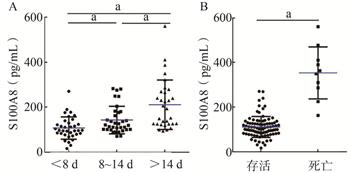
分析社区获得性肺炎(community-acquired pneumonia, CAP)患者入院时血清S100钙结合蛋白A8(S100 calcium-binding protein A8, S100A8)水平与预后之间的关联,并探讨血清S100A8升高的可能危险因素。 收集2018年12月―2020年12月在亳州市人民医院就诊的CAP患者临床信息和血清样本,用酶联免疫吸附试验(enzyme-linked immunosorbent assay, ELISA)检测血清S100A8和炎症因子的水平。 最终招募100名符合条件的CAP患者。随着入院时血清S100A8水平的升高,CAP患者住院时间延长(F=23.562, P=0.005)。期间有10名CAP患者死亡,死亡组血清S100A8水平高于存活组(t=4.352, P=0.004)。logistic回归分析模型分析发现血清S100A8升高是住院时间延长(OR=3.111, 95% CI: 1.112~8.702, P=0.031)和死亡率增加(OR=1.214, 95% CI: 1.058~1.562, P=0.022)的危险因素。Pearson关联性分析发现S100A8水平与炎症因子水平呈正相关。进一步logistic回归分析模型分析发现,年龄(OR=1.230, 95% CI: 1.030~1.528, P=0.044)、高SBP(OR=1.155, 95% CI: 1.011~1.320, P=0.033)以及合并肾脏疾病(OR=2.541, 95% CI: 1.578~6.537, P=0.038)均是CAP患者血清S100A8升高的独立危险因素。 CAP患者入院时血清S100A8水平与不良预后呈正相关,血压升高、合并肾脏疾病的CAP老年患者血清S100A8更易升高。血清S100A8水平可能作为CAP患者预后的一个早期诊断分子标志物。
Objective To explore the correlation between serum S100A8 on admission and the prognosis in patients with community-acquired pneumonia (CAP) as well as the potential risk factors of S100A8 elevation. Methods CAP patients were enrolled from December 2018 to December 2020 in the Department of Respiratory and Critical Care Medicine of Bozhou People's Hospital. Demographic characteristics and clinical information were extracted. Serum samples were collected. The levels of S100A8 and inflammatory cytokines were measured using enzyme-linked immunosorbent assay. Results All 100 patients with CAP were enrolled. The hospital stay was increased in parallel with serum S100A8 on admission among CAP patients (F=23.562, P=0.005). In addition, 10 patients with CAP died during hospitalization. Serum S100A8 level was higher in dead patients than those in alive cases (t=4.352, P=0.004). Moreover, logistic regression analysis found that serum S100A8 elevation was the risk factor of hospital stay prolonging (OR=3.111, 95% CI: 1.112-8.702, P=0.031) and mortality elevation (OR=1.214, 95% CI: 1.058-1.562, P=0.022) in CAP patients. Additionally, Pearson correlation analysis found that S100A8 level was associated with inflammatory cytokines. Further logistic regression analysis found that age (OR=1.230, 95% CI: 1.030-1.528, P=0.044), high systolic pressure (OR=1.155, 95% CI: 1.011-1.320, P=0.033) and comorbidity with renal disease (OR=2.541, 95% CI: 1.578-6.537, P=0.038) were independent risk factors of S100A8 elevation among CAP patients. Conclusions Serum S100A8 level on admission is positively correlated with adverse prognosis in CAP patients. Serum S100A8 is more prone to elevating in older and higher blood pressure patients with renal disease. Consequently, S100A8 may be used as an early serum biomarker of prognosis for CAP patients.
 知识与财富的链接