知识与财富的链接

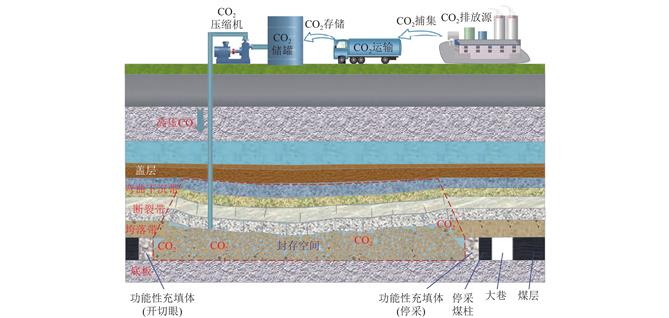
在全球气候变暖和“双碳”目标驱动下,深部碳储空间的高效开发与安全封存成为实现碳中和的关键路径。系统综述了深部咸水层、枯竭油气藏、不可采煤层及玄武岩层等碳储空间的探测技术、场地适宜性评价方法及规模化封存的关键理论技术难题。结果表明:CO2注入引发的多场耦合效应(热-流-力-化学)可能导致断层活化、盖层泄漏及地震风险,需通过多物理场数值模拟与动态监测构建风险评估框架。深部咸水层占我国理论封存潜力的98.64%,但其非均质性显著,适宜性评价需结合地质稳定性(断裂发育、盖层封闭性)和封存能力(孔隙率、渗透率)构建多尺度指标体系,联合层次分析法、GIS及机器学习方法优化选址决策。针对深部碳储空间复杂性,地震与电法联合探测技术可以显著提升储层识别精度,其中全波形反演(FWI)可刻画孔隙-裂隙结构,重磁反演技术实现深部构造建模,多物理场数据融合技术降低反演多解性。在煤矿绿色转型方面,创新提出“负碳充填”技术,通过CO2矿化钢渣、粉煤灰等工业固废制备充填材料,实现高固碳率,同时兼顾生态修复与动力灾害防控。深部不可采煤层CO2封存与煤层气驱替(ECBM)协同效应显著,需优化压裂—驱替—封存全生命周期管理模式。采空区CO2封存则面临碎裂煤岩体复杂渗流-吸附机理挑战,需构建多相动态模型评估游离态、吸附态及溶解态封存潜力。潜力计算方法随储层类型差异显著,咸水层采用封存机理法(构造圈闭、溶解、矿化耦合),枯竭油气藏结合物质平衡法与数值模拟,煤层依赖吸附容量与置换效率评估。注入技术创新方面,微纳米气泡注入技术可提升CO2溶解率,玄武岩“水混合溶解态注入”模式实现高矿化率。未来需强化多学科交叉,通过多物理场联合智能探测与精细成像,突破多类型、立体碳储空间精细探测的行业难题,研发深部负碳高效充填开采材料与技术装备;构建深部立体集成空间CO2封存潜力计算与适宜性评价方法体系,形成技术标准体系和信息决策系统,为“双碳”目标下地质封存规模化应用提供理论与工程支撑。
Driven by global climate change and the “dual carbon” goals, the efficient development and safe storage of deep carbon storage spaces have emerged as a critical pathway to achieve carbon neutrality. This paper systematically reviews the exploration technologies, site suitability evaluation methods, and key theoretical challenges for large-scale carbon storage in deep saline aquifers, depleted oil and gas reservoirs, unminable coal seams, and basalt formations. The study reveals that multiphysical field coupling effects (thermal-fluid-mechanical-chemical) induced by CO2 injection may trigger risks such as fault activation, caprock leakage, and seismic activity, necessitating the construction of a risk assessment framework through multiphysical field numerical simulation and dynamic monitoring. Deep saline aquifers account for 98.64% of China’s theoretical carbon storage potential, but their significant heterogeneity requires suitability evaluation that integrates geological stability (fault development, caprock sealing capacity) and storage capacity (porosity, permeability) to construct a multi-scale index system. Methods such as the analytic hierarchy process (AHP), GIS, and machine learning are combined to optimize site selection decisions. To address the complexity of deep carbon storage spaces, integrated seismic and electrical exploration technologies significantly improve reservoir identification accuracy: full-waveform inversion (FWI) characterizes pore-fracture structures, gravity-magnetic inversion constructs deep structural models, and multiphysical data fusion reduces the non-uniqueness of inversion results.
In the context of green transformation in coal mines, the innovative “negative carbon backfilling” technology is proposed: CO2 is used to mineralize industrial solid wastes such as steel slag and fly ash to prepare backfilling materials, achieving high carbon sequestration rates while balancing ecological restoration and dynamic disaster prevention. The synergistic effect of CO2 storage in deep unminable coal seams and enhanced coalbed methane (ECBM) recovery is significant, requiring optimization of the full-life-cycle management model for “fracturing-displacement-storage”. CO2 storage in goafs faces challenges from the complex seepage-adsorption mechanisms in fractured coal-rock masses, necessitating the development of multiphase dynamic models to assess storage potential in free, adsorbed, and dissolved states. Potential calculation methods vary significantly by reservoir type: Saline aquifers use the storage mechanism method (coupling structural trapping, dissolution, and mineralization), depleted oil and gas reservoirs combine material balance methods with numerical simulation, and coal seams rely on adsorption capacity and displacement efficiency evaluations. In terms of injection technology innovation, micro-nano bubble injection enhances CO2 dissolution rates, while the “water-mixed dissolved-state injection” mode in basalt formations achieves high mineralization rates. Future research must emphasize interdisciplinary integration: Developing intelligent multiphysical field exploration and fine imaging to overcome challenges in detailed characterization of multi-type three-dimensional carbon storage spaces; researching and developing high-efficiency deep negative carbon backfilling materials and technical equipment; and constructing a comprehensive system for calculating CO2 storage potential and evaluating suitability in deep integrated three-dimensional spaces, form technical standard systems and information decision-making platforms, and provide theoretical and engineering support for large-scale geological storage under the “dual carbon”goals.