知识与财富的链接

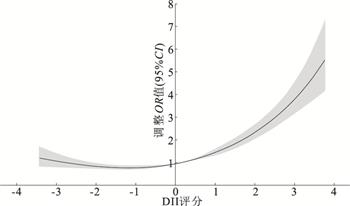
目的 探讨膳食炎症指数(DII)与一年级小学生肥胖患病风险之间的关联,为儿童肥胖预防和干预提供科学依据。 方法 2024年4—6月,采用多阶段整群抽样与方便抽样相结合的方法选取马鞍山市儿童青少年健康成长队列中基线调查的4 059名小学一年级学生作为研究对象。通过半定量食物频率问卷收集儿童饮食信息,计算每位学生的DII评分,按DII四分位数分为Q1、Q2、Q3和Q4组。采用统一的身高体重计测量学生的身高和体重,依据《学龄儿童青少年超重与肥胖筛查》(WS/T 586—2018)判断儿童是否肥胖。采用Logistic回归分析探讨DII评分与学生肥胖风险之间的关系,并进行性别分层分析。 结果 检出肥胖学生895名,检出率为22.0%。Logistic回归分析结果显示,调整协变量后,与DII中Q1组的学生相比,Q3和Q4组的学生肥胖风险增加(Q3:OR=1.43,95%CI=1.12~1.82;Q4:OR=4.14,95%CI=3.32~5.16,P值均 < 0.05);按照性别分层分析,调整协变量后,DII中Q4组,男生(OR=4.83,95%CI=3.61~6.46)的肥胖风险高于女生(OR=3.46,95%CI=2.45~4.90)(P值均<0.01)。限制性立方样条分析显示,DII评分与学生肥胖风险之间呈现“J型”剂量反应关系(P < 0.01)。 结论 DII评分较高可能与儿童肥胖风险的增加有关,在儿童中提倡抗炎饮食可预防和减少肥胖的发生。
Objective To explore the association between the dietary inflammation index (DII) and the risk of obesity in the first-grade primary school students, so as to provide a scientific evidence for the prevention and intervention of childhood obesity. Methods From April to June 2024, a method combining multi-stage cluster sampling and convenience sampling was used to select 4 059 first-grade students from the Ma'anshan Children and Adolescents Health Growth Cohort as study participants. Dietary information was collected through Semi-quantitative Food Frequency Questionnaire, and each student's DII score was calculated. The students were categorized into four groups (Q1, Q2, Q3, Q4) by their DII quartiles. Height and weight were measured using unified electronic height-weight machines, and obesity was diagnosed according to the Screening for Overweight and Obesity in School-age Children and Adolescents (WS/T 586-2018). Logistic regression was employed to investigate the relationship between DII scores and the risk of obesity among students, with gender stratification. Results A total of 895 obese children were identified, with an obesity rate of 22.0%. After adjusting for covariates, compared to students in the DII Q1 group, students in the Q3 and Q4 groups had increased risks of obesity (Q3: OR=1.43, 95%CI=1.12-1.82; Q4: OR=4.14, 95%CI=3.32-5.16, P < 0.05). Gender stratified analysis revealed that, after adjusting for covariates, boys in the DII Q4 group (OR=4.83, 95%CI=3.61-6.46, P < 0.01) had a higher obesity risk than girls in the same group (OR=3.46, 95%CI=2.45-4.90, P < 0.01). Restricted cubic spline analysis showed a "J-shaped" dose-response relationship between DII scores and obesity risk among students (P < 0.01). Conclusion Higher DII scores may be associated with an increased risk of obesity in the first-grade primary school students. It is recommended to promote anti-inflammatory diets in children to prevent and reduce the incidence of obesity.