知识与财富的链接

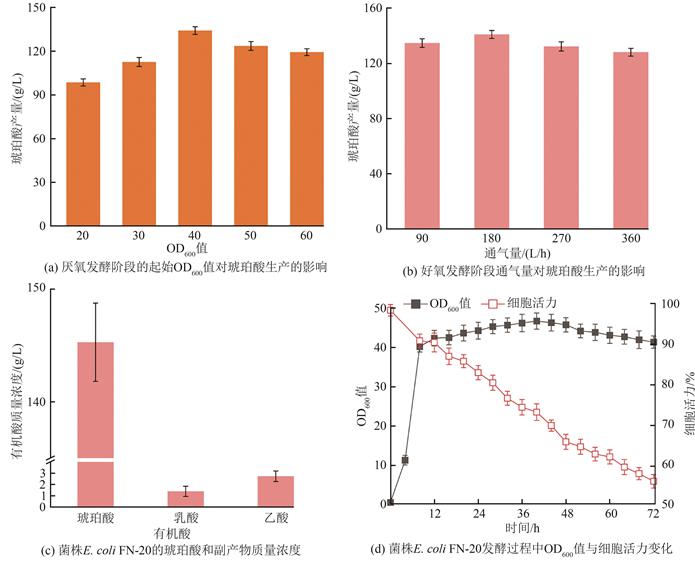
【目的】提高大肠杆菌(Escherichia coli, E. coli)的高渗透压耐受性,实现琥珀酸的高效生产。【方法】通过适应性进化、转录组学分析、反向代谢工程改造和发酵优化等策略,筛选具有高渗透压耐受能力的E. coli。【结果】通过分析琥珀酸发酵生产的关键影响因素,确定了渗透压是导致琥珀酸生产效率降低的关键因素。通过适应性进化策略,筛选获得了一株能够耐受高渗透压的突变菌株E.coli FN-6。借助转录组学分析,获得了与渗透压耐受性相关的关键靶点基因cusC,并通过优化cusC基因表达水平,构建了高渗透压耐受菌株E. coli FN-20。在5 L发酵罐中,菌株E. coli FN-20的琥珀酸产量、产率和生产强度分别达到了145.27 g/L、90.0%和2.01 g/(L·h)。【结论】筛选的高渗透压耐受性E. coli FN-20实现了琥珀酸的高效生产,这为推动琥珀酸的工业化生产提供了新的思路,同时为发酵法生产其他高附加值化学品提供了借鉴。
[Objective] This study aims to enhance the high osmotic pressure tolerance of Escherichia coli (E. coli) for the efficient production of succinic acid.[Method] Adaptive evolution, transcriptomic analysis, reverse metabolic engineering, and fermentation optimization were employed for improving E. coli tolerance to high osmotic pressure.[Result] By analyzing the key factors influencing succinic acid production by fermentation, osmotic pressure was identified as the critical factor reducing succinic acid production efficiency . A mutant strain, E. coli FN-6, with tolerance to high osmotic pressure was obtained through adaptive evolution. The key gene cusC responsible for osmotic pressure tolerance was identified by transcriptomic analysis. After optimization of the expression level of cusC, the engineered strain E.
coli FN-20 showed strong tolerance to high osmotic pressure. In a 5 L fermenter with E. coli FN-20, the succinic acid titer, yield, and productivity were up to 145.27 g/L, 90.0%, and 2.01 g/(L·h), respectively.[Conclusion] The obtained E. coli FN-20 strain with tolerance to high osmotic pressure enabled efficient production of succinic acid. This provides a new approach for the industrial production of succinic acid and provides the reference for producing other high value-added chemicals by fermentation.