知识与财富的链接

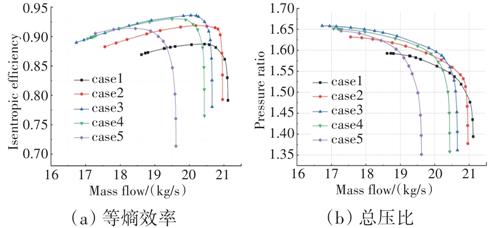
为揭示跨声速风扇转子受脱落冰撞击后叶片真实损伤对气动性能的影响规律,对受损叶片逆向建模,开展叶片前缘不同弯曲方向和形变程度对其气动性能的影响研究。结果表明:前缘向吸力面弯曲叶片case1和case2失速裕度相对减小62%和29%,前缘向压力面弯曲叶片case4和case5失速裕度相对减小11.9%和19.5%;叶片前缘向压力面弯曲导致通道通流能力降低,流量减小,吸力面曲率增大,加剧了边界层分离。叶片前缘向吸力面弯曲使通道通流能力提高,流量增大,损伤处弦向截面呈S型,预压缩作用提高了总压比,吸力面无遮盖段呈凹面抑制了边界层分离;在近失速点,叶片case1和case2攻角增大,通道外高速区使气流速度剧烈变化诱发叶片失速。叶片case4和case5吸力面曲率增大,边界层严重分离诱发叶片失速。前缘向吸力面弯曲使叶片损伤处弦向截面呈S型,有利于抑制边界层分离,对气动性能影响较小,但叶片失速裕度明显降低,威胁飞行安全;前缘向压力面弯曲使叶片气动性能明显降低,但对失速裕度影响较小。
In order to reveal the influence of real damage on the aerodynamic performance after ice-shedding impact on transonic fan
rotor blades, reverse modeling of the damaged blades was performed, and the effects of different bending directions and deformation
degrees of the blade leading edge on aerodynamic performance were investigated. The results show that the stall margins of Case 1 and
Case 2 with blade leading edges bending toward the suction surface are relatively reduced by 62% and 29%, and the stall margins of Case 4
and Case 5 with blade leading edges bending toward the pressure surface are relatively reduced by 11.9% and 19.5%. Bending of the lead?
ing edge towards the pressure surface reduces blade passage flow capacity, decreases mass flow rate, increases suction surface curvature,
and aggravates boundary layer separation.
Bending towards the suction surface improves passage flow capacity, increases mass flow rate,
forms an S-shaped chordwise section at the damaged area, increases the total pressure ratio through pre-compression effect, and inhibits
boundary layer separation due to the concave profile of the uncovered suction surface segment. At near-stall conditions, the blade
incidence angle of Case 1 and Case 2 increases, and the high-speed zone outside the channel causes the airflow speed to change drasti?
cally, inducing blade stall. For Case 4 and Case 5, the curvature of the blade suction surface increases, causing severe boundary layer
separation and leading to blade stall. Leading-edge bending towards the suction surface forms an S-shaped chordwise section at the dam?
aged area, which is conducive to suppressing boundary layer separation with minor impact on aerodynamic performance; however, the blade
stall margin is significantly reduced, threatening flight safety; leading-edge bending towards the pressure surface significantly degrades
aerodynamic performance but has a smaller impact on stall margin.