 知识与财富的链接

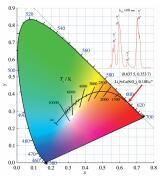
采用硅酸盐作为基质材料,通过高温固相法合成了Li4SrCa(SiO4)2∶Eu3+红色荧光粉。通过X射线粉末衍射、X射线光电子能谱、透射电镜和荧光光谱,对所得样品的物相、形貌及其发光性能进行了表征分析。结果表明,掺入Eu3+后,Li4SrCa(SiO4)2的晶体结构并没有发生改变。在393 nm光激发下,荧光粉的荧光光谱中693 nm处发射峰强度最强。以693 nm作为监测波长,荧光激发峰分别为361 nm (7F0→5D4)、375 nm (7F0→5G3)、413 nm (7F0→5D3)、393 nm (7F0
Li4SrCa(SiO4) 2:Eu3+ red phosphor was synthesized by a high-temperature solid-phase method using silicate as a host material. The phase, morphology, and luminescence properties of the powder were characterized by X-ray diffraction, X-ray photoelectron spectroscopy, transmission electron microscopy, and fluorescence spectroscopy. The results showed that the crystal structure does not change after the addition of the europium ion. Under the light excitation at 393 nm, the emission peak intensity of the sample was the strongest at 693 nm. With 693 nm as the monitoring wavelength, the main excitation peaks were 361 nm (7F0→5D4), 375 nm (7F0→5G3), 413 nm (7F0→5D3), 393 nm (7F0→5L6), and 464 nm (7F0→5D2), which suggests that the phosphor has good absorption to near-ultraviolet and blue light, and has the potential to produce white light-emitting diodes. The effect of Eu3+ doped concentration on the luminescence intensity of phosphor was studied by emission spectroscopy. When the doped concentration of europi- um ion (molar fraction, x) was equal to 0.10, the emission intensity of the sample was the strongest, and the sample emitted red light. The mechanism of concentration quenching was analyzed by the relationship between Dexter strength and concentration.
