知识与财富的链接

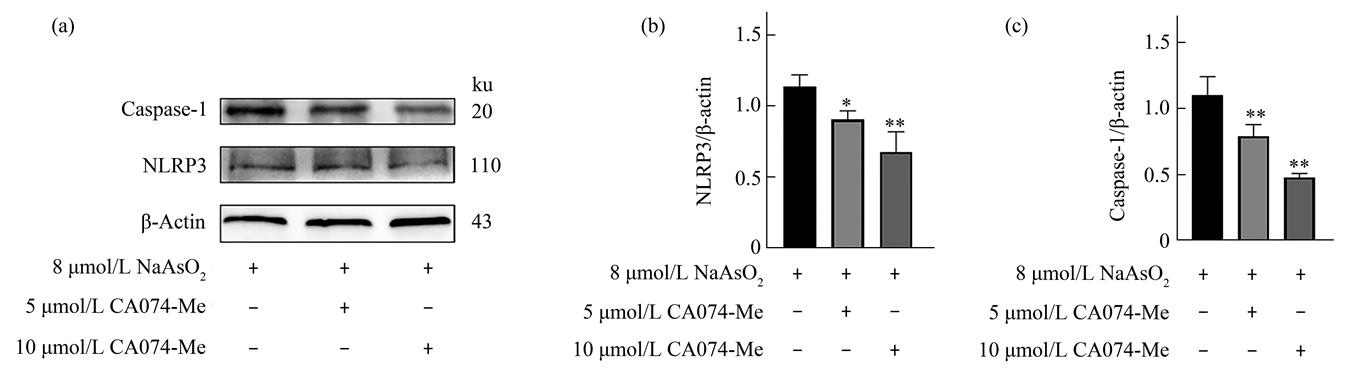
目的 探究组织蛋白酶B (CTSB)介导NLRP3小体在砷致小胶质细胞(BV-2)炎症激活中的作用。方法 取处于对数生长期的BV-2细胞,分别暴露于终浓度为0、2、4、8μmol/L亚砷酸钠(NaAsO2)溶液培养24 h,检测细胞活性,测定各组细胞内CTSB和细胞焦亡相关蛋白NLRP3、Caspase-1、IL-18、IL-1β的表达水平。流式细胞仪检测胞内溶酶体膜稳定性。基于实验结果,增设CTSB抑制剂组(5μmol/L CA074-Me+8μmol/L NaAsO2、10μmol/L CA074-Me+8μmol/L NaAsO2),检测两组细胞内炎症相关蛋白NLRP3、Caspase-1和IL-1β、IL-18的表达水平。结果 与对照组比较,各染砷组细胞抑制率增高,呈现剂量效应关系,溶酶体膜稳定性下降,差异有统计学意义(P<0.01),胞内CTSB、NLRP3、IL-1β、IL-18、Caspase-1表达增高,差异有统计学意义(P<0.01);与对照组(8μmol/L NaAsO2
Objective To explore the role of CTSB (cathepsin B)-mediated NLRP3 bodies in arsenic-induced inflammatory activation of mouse microglial BV-2 cell.Methods BV-2 cells in logarithmic growth phase were respectively exposed to NaAsO2 solution at the final concentration of 0, 2, 4 and 8 μmol/L for 24 h. Cell viability was detected by CCK-8 assay. The levels of intracellular CTSB, NLRP3, Caspase-1, IL-18, and IL-1β were determined by Western blot. The intracellular lysosome level was detected by flow cytometry analysis. According to the experimental results, CTSB inhibitor group (5 μmol/L CA074-Me+8 μmol/L NaAsO2,10 μmol/LCA074-Me+8 μmol/L NaAsO2) was added to detect the expression of NLRP3, Caspase-1, IL-1β and IL-18 in the two groups.Results Compared with the control group, the cell inhibition rate of all exposed groups increased in a dose-dependent manner, the level of lysosome integrity decreased, the difference was statistically significant (P<0.
01). The expression of CTSB, NLRP3, IL-1β and IL-18, Caspase-1 increased significantly, the difference was statistically significant (P<0.01). Compared with the inhibitor group, the intracellular CTSB, NLRP3, IL-1β and IL-18, Caspase-1 levels of BV-2 cells exposed to 8 μmol/L NaAsO2 without inhibitor were significantly higher (P<0.01).Conclusion NaAsO2 can induce the increase of CTSB level in microglia, mediate the activation of microglia by NLRP3 inflammatory bodies, promote the release of inflammatory factors and damage the central nervous system.