知识与财富的链接

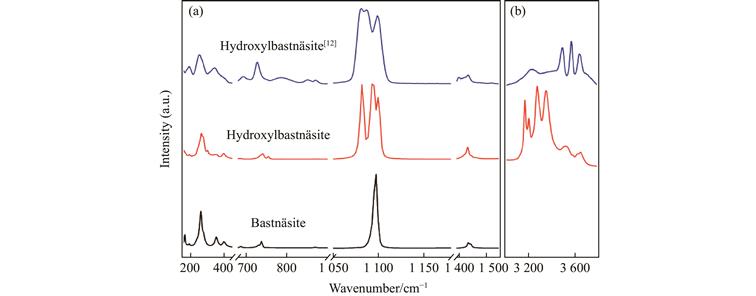
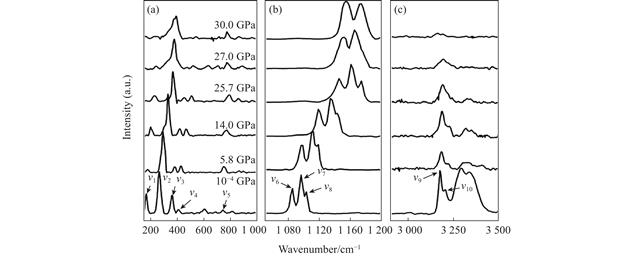
羟碳铈矿是一种重要的含水稀土氟碳酸盐矿物,了解其高压下的物理性质对于探讨氟和水的存在对碳酸盐矿物物性的影响具有重要意义。运用金刚石压腔(DAC)技术与激光拉曼光谱,在室温下原位开展了羟碳铈矿的高压拉曼光谱学研究。结果显示,在常压下由[CO3]2–振动引起的拉曼峰共有6条:面内弯曲振动引起的拉曼峰位于604、742 cm–1,对称伸缩振动引起的拉曼峰位于1 083、1 096和1 103 cm–1,而1 430 cm–1属于非对称伸缩振动;由[OH]–振动引起的拉曼峰有6条,分别位于3 174、3 197、3 290、3 345、3 526和3 648 cm–1。随着压力的增加(0~30 GPa),未发现拉曼峰的消失或新拉曼峰的出现,表明在测试压力范围内羟碳铈矿未发生相变。拉曼峰均往高波数偏移,其位移与压力呈现良好的线性正相关关系,由[CO3]2–的面内弯曲振动引起的拉曼峰对压力的依赖系数最小,为2(0.06) cm–1/GPa,而基团外振动引起的拉曼峰对压力的依赖系数最大,为4.2(0.11) cm–1/GPa。对比无水碳酸盐高压下拉曼峰的位移,认为[OH]–和F–的存在导致羟碳铈矿高压下结构中[CO3]2–基团的振动模式对压力的依赖性发生变化,进一步影响到晶体高压下的各向异性。这为研究地球深部碳酸盐的高压物性行为提供了新的启示。
Understanding the physical properties under high pressure of hydroxylbastnäsite-(Ce), an important hydrous rare earth element (REE) fluorocarbonate mineral, can provide key information to explore the effect of fluorine and hydroxyl on high-pressure behavior of carbonate minerals. Here Raman spectroscopy combined with diamond anvil cell (DAC) technology was employed to investigate the high-pressure properties of hydroxylbastnäsite-(Ce). At ambient conditions, the in-plane vibration bands of [CO3]2– are observed at 604 cm–1 and 742 cm–1, the symmetrical stretching bands are at 1 083, 1 096, and 1 103 cm–1, and the asymmetric stretching vibration is at 1 430 cm–1. Six vibration peaks of [OH]– are at 3 174, 3 197, 3 290, 3 345, 3 526 and 3 648 cm–1, respectively. The observation of three discrete [CO3]2– symmetrical stretching bands, instead of one, indicates that there may be at least three structurally-nonequivalent [CO3]2– groups in the hydroxyl-bästnasite-(Ce) structure.
On compression, all of the Raman peaks show a continuous shift to the higher frequency and no new peaks appear, suggesting that no phase transition occurs up to 30 GPa at room temperature. The slope of the in-plane bending vibration of [CO3]2– is the smallest, about 2(0.06) cm–1/GPa. Compared with the anhydrous carbonate, it can be inferred that the [OH]– and F– in the structures of hydroxylbastnäsite-(Ce) lead to the compression anisotropy. Our results provide new clues for studying the high-pressure physical behavior of carbonates in the deep earth.