知识与财富的链接

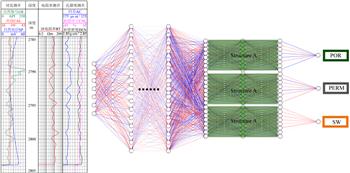
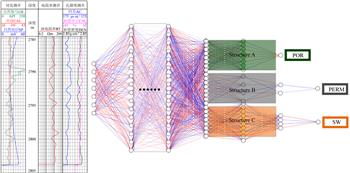
基于多任务神经网络模型, 提出一种多任务测井储层参数预测方法, 利用测井数据对储层孔隙度、渗透率及含水饱和度同时进行预测.分别采用同架构和异架构多任务模型对测井储层参数进行预测, 通过数值实验对比, 多任务预测模型有效提升了单任务储层参数预测模型的效果, 且提升幅度与模型结构有关, 异架构多任务模型的总体预测效果好于同架构多任务模型.以平均相对误差(MAPE)作为模型评价标准, 针对本研究所采用的数据集, 同架构多任务模型的孔隙度、渗透率和含水饱和度在测试集上的MAPE约为6%、17%和9%, 相较于单任务模型, 预测效果分别提升约30%、20%和10%.异架构多任务模型的孔隙度、渗透率和含水饱和度, 在测试集上的MAPE约为6%、13%和6%, 相较于单任务模型分别提升超过2%、60%和10%.
Multitasking learning has been successful in many applications of machine learning from natural language processing to computer vision. Multitasking learning has good generalization and has advantages in dealing with complex problems of internal relations, the correlation in tasks and hidden information could be used to improve the performance of neural network model. The reservoir parameters prediction with logs is not suitable to be divided into single independent sub-problems, for the calculation processing of reservoir parameters is related with each other, and they need to do iteration for several times. If using single-task learning method, the relevant information among reservoir parameters might be ignored. This paper researches on the method of reservoir parameters prediction based on multitask neural network model, which simultaneously estimates porosity, permeability and water saturation by logs.
The results show that the multitask reservoir parameter prediction model can effectively improve the prediction performance of single-task reservoir parameter prediction model, and the performance improvement range is decided by the model structure. The overall prediction performance of the different structure multitask models is better than that of the same structure multitask models. Using Mean Absolute Percentage Error (MAPE) as the model evaluation indices, for data set used in this research, the MAPE of Porosity (POR), Permeability (PERM) and Water Saturation (SW) on the test set of the same structure multitask model are around 6%, 17% and 9% respectively, compared with the single-task model, the prediction performance are improved around 30%, 20% and 10% respectively. The MAPE of porosity, permeability and water saturation of the multitask model with different structures on the test set are about 6%, 13% and 6%, the prediction performance of three reservoir parameters are 2%, 60% and 10% higher than that of the single-task model. Experiments show that multitask reservoir parameter prediction model could improve the prediction performance through the relationship between reservoir parameters.