 知识与财富的链接


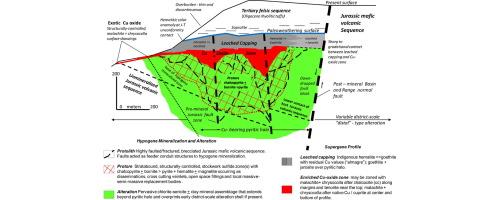
A Late Cretaceous to Early Oligocene episode of paleoweathering and supergene activity has been identified within the Jurassic-age (170 Ma) Humboldt mafic complex (HMC) and associated Boyer Ranch Formation of west-central Nevada, USA. This episode is responsible for significant subaerial weathering, erosion, oxidation and most importantly local supergene metal enrichment which could potentially have a major economic impact upon iron oxide copper-gold (IOCG)-style mineralization within the complex and in the Boyer Ranch Formation. Paleoweathering profiles that developed on the exposed Jurassic surface during this time now mark an angular unconformity (J-T unconformity) with a stratigraphically overlying, Tertiary (Oligocene) rhyolitic volcanic-volcaniclastic sequence.Differential uplift of the Jurassic surface is a direct result of the Middle and/or Late Jurassic Luning-Fencemaker compressional overthrust faulting event during which the entire complex was tectonically transported to its present location. The uplifted Jurassic paleosurface experienced one or more cycles of weathering, erosion, depression of the water table and uninterrupted supergene activity beginning at the end of the Cretaceous and possibly accelerating during the Paleocene-Eocene Thermal Maximum Event (∼56 Ma). Geochemically mature supergene Cu-oxide profiles developed over exhumed mineralized sections in terrains with favorable fault block movements. These paloweathering systems evolved from moderately acidic pH to near-neutral or slightly alkaline pH environments over time. High protolith reactivity and low hypogene pyrite concentrations modified acidity of supergene fluids thus limiting Cu mobility.Profiles that survived erosion were later buried and preserved by the Oligocene-age rhyolitic volcanic-volcaniclastic sequence before the onset of mid-Tertiary Basin and Range normal faulting. Subsequent partial unroofing of overlying Tertiary volcanic cover resulted in further erosion of some profiles. Erosional remnants mapped in the field include all or some components of the original supergene Cu-oxide profiles. Drilling results suggest profiles that remain buried are generally intact.Although this field-oriented study is considered preliminary, it concludes that known Jurassic-age IOCG-style mineral occurrences in the central HMC have been subjected to prolonged subaerial paleoweathering and supergene activity that has not been previously recognized. Where complete or nearly complete profiles are preserved, efficient cumulative Cu-enrichment to potentially ore grades has been documented in well defined oxide zones. These findings can be extrapolated to the entire J-T unconformity along which concealed and enriched deposits may exist. As such, the unconformity is considered a prime exploration target that is highly prospective for new discoveries of economically viable, supergene-enriched IOCG resources.