
Logo 知识与财富的链接
Chondroitin-based nanoplexes as peptide delivery systems – Investigations into the self-assembly process,solid-state and extended release characteristics

Chondroitin-based nanoplexes as peptide delivery systems – Investigations into the self-assembly process,solid-state and extended release characteristics

ISSN:0939-6411
2015年第93卷第期
1. School of Pharmacy and Pharmaceutical Sciences, Trinity College Dublin, Dublin 2, Ireland;2. INSERM U1066, Micro et Nanomédecines Biomimétiques, Angers, France;3. Bradford School of Pharmacy, Centre for Pharmaceutical Engineering Science, Faculty of Life Sciences, University of Bradford, Richmond Rd., BD71DP Bradford, W.Yorks., UK;4. School of Medicine, Trinity College Dublin, Dublin 2, Ireland;1. Pharmacokinetic, Nanotechnology and Gene Therapy Group (PharmaNanoGene), Faculty of Pharmacy, Centro de Investigación Lascaray Ikergunea, University of the Basque Country UPV/EHU, Vitoria-Gasteiz, Spain;2. Université Catholique de Louvain, Louvain Drug Research Institute, Pharmaceutics and Drug Delivery, Brussels 1200, Belgium;1. Department of Pharmacology, School of Medicine, Tehran University of Medical Sciences, Tehran, Iran;2. Department of Biology, Faculty of Food Industry & Agriculture, Standard Research Institute (SRI), Karaj, Iran;3. Department of Mechanical and Industrial Engineering, College of Engineering, Qatar University, Doha 2713, Qatar;4. Biomedical Research Center, Qatar University, Doha 2713, Qatar;5. Department of Biological Sciences, Institute for Advanced Studies in Basic Sciences (IASBS), Zanjan, Iran;6. Department of Biology, College of Science, Salahaddin University-Erbil, Kurdistan Region, Iraq;7. Department of Medical Analysis, Faculty of Science, Tishk International University, Erbil, Iraq;8. Department of Pathological Analysis, College of Science, Knowledge University, Erbil 074016, Kurdistan Region, Iraq;9. Department of Physics, University of Kurdistan, P.O. Box 416, Sanandaj, Iran;10. Royan Institute for Stem Cell Biology and Technology (RI-SCBT), Tehran, Iran;11. Department of Neurology, Babol University of Medical Sciences, Babol, Iran;12. Department of Nanotechnology, Faculty of Advanced Science and Technology, Tehran Medical Sciences, Islamic Azad University, Tehran, Iran;13. Institute of Biochemistry and Biophysics, University of Tehran, Tehran, Iran;14. Department of Medical Nanotechnology, School of Advanced Technologies in Medicine, Tehran University of Medical Sciences, Tehran, Iran;1. Discipline of Biochemistry, University of KwaZulu-Natal, Private Bag X 54001, Durban 4000, South Africa;2. Department of Chemistry, University of Zululand, Private Bag X1001, KwaDlangezwa 3886, South Africa;3. Department of Applied Physics, Hospital Universitario San Cecilio, University of Granada, Granada, Spain


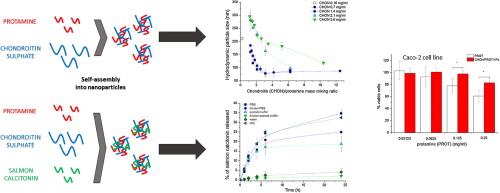
A new type of self-assembled polyelectrolyte complex nanocarrier composed of chondroitin (CHON) and protamine (PROT) was designed and the ability of the carriers to bind salmon calcitonin (sCT) was examined. The response of sCT-loaded CHON/PROT NPs to a change in the properties of the liquid medium, e.g. its pH, composition or ionic strength was studied and in vitro peptide release was assessed. The biocompatibility of the NPs was evaluated in Caco-2 cells.CHON/PROT NPs were successfully obtained with properties that were dependent on the concentration of the polyelectrolytes and their mixing ratio. X-ray diffraction determined the amorphous nature of the negatively charged NPs, while those with the positive surface potential were semi-crystalline. sCT was efficiently associated with the nanocarriers (98–100%) and a notably high drug loading (13–38%) was achieved. The particles had negative zeta potential values and were homogenously dispersed with sizes between 60 and 250 nm. CHON/PROT NPs released less than 10% of the total loaded peptide in the first hour of the in vitro release studies. The enthalpy of the decomposition exotherm correlated with the amount of sCT remaining in NPs after the release experiments. The composition of medium and its ionic strength was found to have a considerable influence on the release of sCT from CHON/PROT NPs. Complexation to CHON markedly reduced the toxic effects exerted by PROT and the NPs were compatible and well tolerated by Caco-2 cells.

关键词:
认领
收 藏
点 赞
认领进度
0 %

发表评论

ISSN:0939-6411
2015年第93卷第期

用户信息设置