知识与财富的链接

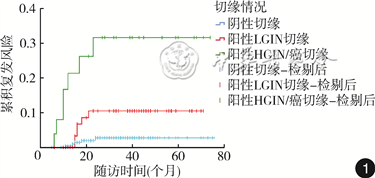
目的探究早期胃癌及癌前病变内镜黏膜下剥离术(endoscopic submucosal dissection, ESD)后切缘阳性的危险因素, 并随访复发情况。方法回顾性收集2015年1月—2020年12月在福建省立医院经ESD治疗的489例早期胃癌及癌前病变患者的内镜、临床及病理资料, 根据切缘情况分为切缘阴性组(371例)、切缘低级别上皮内瘤变(low grade intraepithelial neoplasia, LGIN)组(79例)及切缘高级别上皮内瘤变(high grade intraepithelial neoplasia, HGIN)或癌组(39例)。采用logistic回归分析切缘阳性的危险因素, Kaplan-Meier法和log-rank检验对比不同切缘组复发风险, 采用Cox比例风险回归模型探讨阳性者复发的相关因素。结果 489例患者中, 切缘阳性率24.1%(118/489), 其中HGIN或癌占33.1%(39/118)。病灶面积>10 cm2(OR=1.58, 95%CI:1.13~2.08, P=0.033)、存在溃疡(OR=2.92, 95%C...
Objective To investigate the risk factors for positive margins after endoscopic submucosal dissection (ESD) for early gastric cancer and precancerous lesions, and to follow up the recurrence. Methods The endoscopic, clinical and pathological data of 489 patients with early gastric cancer or precancerous lesions treated by ESD in Fujian Provincial Hospital from January 2015 to December 2020 were retrospectively collected. They were categorized into a negative group (371 cases), a low-grade intraepithelial neoplasia (LGIN)-positive group (79 cases), and a high-grade intraepithelial neoplasia (HGIN) or cancer-positive group (39 cases) according to the different margins. Logistic regression was used to analyze the risk factors for positive margins, the Kaplan-Meier method and log-rank test to compare the risk of recurrence in different margin groups, and the Cox proportional risk regression model to explore the associated factors that caused recurrence in those with positive margins. Results In the 489 patients, the positive resection margin rate was 24.1% (118/489), of which HGIN or cancer accounted for 33.1% (39/118). LGIN-positive margin was more likely to occur for lesions larger than 10 cm2 (OR=1.58, 95%CI: 1.13-2.08, P=0.033), in the presence of ulcers (OR=2.92, 95%CI: 1.37-4.54, P=0.012) and for 1-2 years of ESD experience [OR=1.69 (1-2 years VS 5-6 years), 95%CI: 1.51-1.94, P=0.026]. Those located in the upper 1/3 of the stomach [OR=3.64 (upper 1/3 VS lower 1/3), 95%CI: 1.27-5.50 P=0.010] and submucosal infiltration (SM1 VS M1+M2: OR=2.37, 95%CI: 1.04-5.72, P=0.028; SM2 VS M1+M2: OR=6.08, 95%CI: 1.31-12.75, P=0.002) were high risk factors for HGIN/cancer-positive margin. Postoperative follow-up was completed in 337 patients, with a median follow-up time of 26.0 (22) months. The overall cumulative recurrence was 5.3% (18/337), 2.1% (5/239) in the negative margin group, 8.3% (6/72) in the LGIN-positive margin group, and 26.9% (7/26) in the HGIN/cancer-positive group, with statistically significant differences among the 3 groups (P<0.05). Risk factors for recurrence in the positive margin group included positive basal margins (HR=5.17, 95%CI: 1.47-14.09, P=0.011) and SM1 invasion (HR=4.82, 95%CI: 1.38-14.77, P=0.013). Conclusion Positive margins after ESD for early gastric cancer and precancerous lesions are related to lesion location, size, presence of ulceration, depth of infiltration, and endoscopists'' experience. The overall risk of recurrence is higher in those with positive margins than in those with negative margins. Additional treatments need to be considered comprehensively for those with submucosal invasion and positive basal margins.