知识与财富的链接

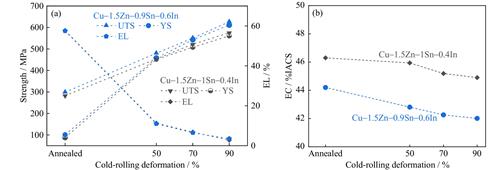
固溶强化铜合金具有成分和制造工艺简单、力学与导电综合性能高、成本低等优点,被广泛应用于高铁轨道接触线、电子元器件接插件等领域。突破低合金化和高性能化之间的矛盾,是固溶强化铜合金开发面临的一个重要挑战。本研究以典型固溶强化Cu–4Zn–1Sn合金为研究对象,提出采用In元素替代Zn和Sn元素实现低合金化的思路,设计并制备了Cu–1.5Zn–1Sn–0.4In和Cu–1.5Zn–0.9Sn–0.6In两种新型合金,合金元素的总含量分别降低43%和41%,而退火态的抗拉强度(UTS)和导电率(EC)的乘积分别提升14%和15%。经90%变形量冷轧后,两种新合金的UTS分别达到576 MPa和627 MPa,EC导电率分别为44.9%IACS和42.0%IACS,UTS与EC的乘积比退火态合金提升了97%和99%。冷轧态合金中位错大量增殖,位错强化效果分别达到332 MPa和356 MPa,是力学性能显著提升的主要原因。
Solid solution-strengthened copper alloys have the advantages of a simple composition and manufacturing process, high mechanical and electrical comprehensive performances, and low cost; thus, they are widely used in high-speed rail contact wires, electronic component connectors, and other devices. Overcoming the contradiction between low alloying and high performance is an important challenge in the development of solid solution-strengthened copper alloys. Taking the typical solid solution-strengthened alloy Cu–4Zn–1Sn as the research object, we proposed using the element In to replace Zn and Sn to achieve low alloying in this work. Two new alloys, Cu–1.5Zn–1Sn–0.4In and Cu–1.5Zn–0.
9Sn–0.6In, were designed and prepared. The total weight percentage content of alloying elements decreased by 43% and 41%, respectively, while the product of ultimate tensile strength (UTS) and electrical conductivity (EC) of the annealed state increased by 14% and 15%. After cold rolling with a 90% reduction, the UTS of the two new alloys reached 576 and 627 MPa, respectively, the EC was 44.9%IACS and 42.0%IACS, and the product of UTS and EC (UTS × EC) was 97% and 99% higher than that of the annealed state alloy. The dislocations proliferated greatly in cold-rolled alloys, and the strengthening effects of dislocations reached 332 and 356 MPa, respectively, which is the main reason for the considerable improvement in mechanical properties.