知识与财富的链接

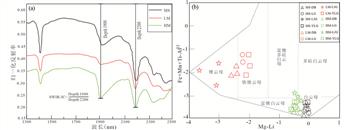
可尔因稀有金属矿田位于青藏高原东缘的松潘-甘孜造山带中段,已探明的Li2O资源量超4Mt,是新近发现的一处超大型伟晶岩型稀有金属资源基地。然而,目前对可尔因矿田的岩浆-热液演化过程和指针矿物勘查方法的研究还较为薄弱,其成因机制与有效勘查指标仍需进一步研究,以便更好地指导区域内同类型矿田的勘查评价。白云母是伟晶岩中最常见的造岩矿物之一,其光谱特征与矿物化学成分可有效指示岩浆-热液的演化过程,为矿田勘探提供重要依据。本文以可尔因矿田党坝、李家沟、龙古和业隆沟等矿床的伟晶岩中的白云母为研究对象,开展了显微结构观察、短波红外光谱测量和电子探针分析。基于白云母的岩相学以及短波热红外光谱特征结果表明,该地区伟晶岩中存在3种类型白云母:(1)原生白云母(MS),形成于岩浆阶段,表现出相对贫硅(6.07apfu)、铁(0.11apfu)而富铝(5.80apfu)特征,锂含量介于0.03~0.10apfu, Pos2200集中于2200.2~2207.6nm(平均波长2202.5nm),伊利石光谱成熟度(IC值)集中于0.15~0.72;(2)富锂白云母(LM),形成于岩浆-热液过渡阶段,具有相对富硅(6.16apfu)、铁(0.36apfu)而贫铝(5.48apfu)特征,锂含量最高介于1.63~4.31apfu, Pos2200集中于2197.6~2199.2nm(平均波长为2198.8nm),IC值>4.3;(3)热液白云母(HM),热液交代作用阶段,表现出相对富硅(6.21apfu)而贫铝(5.38apfu)、铁(0.18apfu)特征,Pos2200集中于2195.6~2197.0nm(平均波长为2196.1nm),IC值在2.99~3.82之间,锂含量介于0.01~0.26apfu。综合分析发现,从MS→LM→HM表现为一个连续的地质演化序列,其Si、Al、Fe元素含量与Pos2200峰值变化关系紧密。随着岩浆演化程度的升高,Si含量逐渐增加,Fe、Al含量和Pos2200峰值则表现出降低的趋势;同时,Li含量呈现出先升高后降低的趋势。原生白云母(MS)形成温度309.44~448.78℃、压力大于6.0GPa;富锂白云母(LM)形成温度为248.16~288.44℃,压力在5.61~5.97GPa之间;而热液白云母(HM)形成温度低,约为209.84~219.14℃,压力略减,大约在5.56~5.78GPa间。当白云母Pos2200位于2198.2~2199.2nm且IC值>4.3时,可作为可尔因矿田锂矿化的重要找矿标志之一。
The Ke'eryin rare metal ore field is located in the middle section of the Songpan-Ganzi orogen in the eastern part of the Tibetan Plateau. It has more than 4 million tons of proven Li2O resources and is a newly discovered ultra-large pegmatite-type rare metal resource base. However, research on the magmatic-hydrothermal evolution of the Ke'eryin ore field and the indicator mineral exploration method is relatively weak, and its genesis and effective exploration indicators need further study to better guide the exploration and evaluation of similar deposits in the region. Muscovite, a common rock-forming mineral in pegmatites, has spectral characteristics and chemical compositions that effectively indicate the magmatic-hydrothermal evolution and provide critical insights for ore exploration. In this paper, this study focuses on muscovite from the pegmatites in the Dangba, Lijiagou, Longgu, and Yelonggou deposits in the Ke'eryin ore field was studied through micro-structural observation, short-wave infrared spectroscopy, and electron probe microanalysis. Based on the petrography and short-wave infrared spectroscopy of muscovite, three types of muscovite were found in the pegmatites of the area: ① Primary muscovite (MS), formed during the magmatic stage, is relatively poor in Si (6.07apfu) and Fe (0.11apfu) but rich in Al (5.80apfu), with Li content between 0.03apfu and 0.10apfu. Its Pos2200 is concentrated between 2200.2nm and 2207.6nm (average wave length 2202.5nm), andthe illite crystallinity (IC value) is between 0.15 and 0.72. ② Lithium-rich muscovite (LM), formed during the magmatic-hydrothermal transition stage, is relatively rich in Si (6.16apfu) and Fe (0.36apfu) but poor in Al (5.48apfu), with Li content as high as between 1.63apfu and 4.31apfu. Its Pos2200 is between 2197.6nm and 2199.2nm (average wave length 2198.8nm), and the IC value is greater than 4.3. ③ Hydrothermal muscovite (HM), formed during the hydrothermal alteration stage, is relatively rich in Si (6.21apfu) but poor in Al (5.38apfu) and Fe (0.18apfu), with Pos2200 between 2195.6nm and 2197.0nm (average wave length 2196.1nm), IC value between 2.99 and 3.82, and Li content between 0.01apfu and 0.26apfu. Comprehensive analysis shows that MS, LM, and HM form a continuous geological evolution sequence, with close relationships between the content changes of Si, Al, Fe elements and the Pos2200 peak. As magmatic evolution progresses, Si content increases, while Fe, Al content, and Pos2200 peak decrease. Meanwhile, lithium content first rises and then falls. The formation temperature of primary muscovite (MS) is between 309.44℃ and 448.78℃, with a pressure greater than 6.0GPa. Lithium- rich muscovite (LM) forms at 248.16℃ to 288.44℃, with pressure between 5.61GPa and 5.97GPa. Hydrothermal muscovite (HM) forms at a lower temperature, approximately 209.84℃ to 219.14℃, with pressure slightly reduced to between 5.56GPa and 5.78GPa. This indicates a coherent and ordered evolution process for these three types of muscovite. When the Pos2200 of muscovite is between 2198.2nm and 2199.2nm and the IC value is greater than 4.3, it can be considered one of the important exploration markers for lithium mineralization in the Ke'eryin ore field.