知识与财富的链接

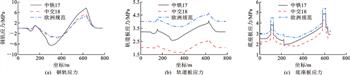
建立了考虑钢轨、扣件、轨道板、底座板、滑动层、砂浆层、桥梁、摩擦板和端刺等部件的(117.9+240.0+117.9) m高速铁路预应力混凝土矮塔斜拉桥-无砟轨道系统仿真模型;以铁路桥涵规范TB 10002—2017、公路规范JTG 3362—2018和欧洲规范Eurocode 2为例,首次探讨了无砟轨道收缩徐变效应下高速铁路大跨度矮塔斜拉桥上无缝线路受力特性;分析了存梁时间、混凝土相对湿度等设计参数的影响。研究结果表明:随着服役时间的延长,轨道结构的受力逐渐增大;单独考虑桥梁收缩徐变效应时,钢轨最大拉应力为4.9 MPa,出现在右侧梁端处,最大压应力为5.2 MPa,出现在固结机构附近;单独考虑无砟轨道收缩徐变效应时,钢轨最大拉应力为0.9 MPa,最大压应力为1.1 MPa,均出现在右侧梁端处;同时考虑桥梁和轨道的收缩徐变效应时,钢轨最大拉应力为7.7 MPa,出现在右侧梁端处,最大压应力为6.5 MPa,出现在固结机构附近。延长存梁时间、加强混凝土养护可减小收缩徐变效应对轨道结构的影响。研究结果可为大跨度桥梁与无砟轨道设计提供重要参考。
A simulation model of (117.9+240.0+117.9) m extradosed cable-stayed bridge and ballastless track system with prestressed concrete for high-speed railway was established in consideration of rails, fasteners, track plates, base plates, sliding layers, mortar layers, bridges, friction plates, and end spurs. With the railway bridge and culvert specification TB 10002—2017, highway specification JTG 3362—2018, and European specification Eurocode 2 as reference standards, the mechanical characteristics in seamless lines on long-span extradosed cable-stayed bridges for the high-speed railway under shrinkage and creep effects of ballastless tracks were investigated firstly, and the influence of design parameters such as storage time of girders and relative humidity of concrete was analyzed. The results show that with the prolongation of service time, the stress of track structures increases gradually. When the shrinkage and creep effects of the bridge alone are considered, the maximum tensile stress of the rail is 4.9 MPa, which appears at the end of the girder at the right side, and the maximum compressive stress is 5.2 MPa, which appears near the consolidation mechanism.
When the shrinkage and creep effects of the ballastless track alone are considered, the maximum tensile stress of the rail is 0.9 MPa, and the maximum compressive stress is 1.1 MPa, both of which appear at the end of the girder at the right side. When the shrinkage and creep effects of the bridge and the track are considered at the same time, the maximum tensile stress of the rail is 7.7 MPa, appearing at the end of the girder at the right side, and the maximum compressive stress is 6.5 MPa, appearing near the consolidation mechanism. Prolonging the storage time of the girder and strengthening the concrete maintenance can reduce the influence of shrinkage and creep effects on the rail structure. The research results can provide an important reference for the design of long-span bridges and ballastless tracks.