知识与财富的链接

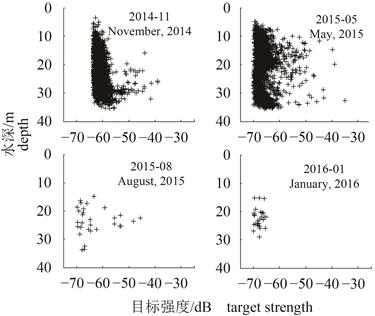
在2014年11月至2016年1月间的不同季节,利用便携式分裂波束科学探鱼仪对海南陵水湾口海域的鱼类资源进行了4次声学调查。通过回波积分方法并结合拖网采样对调查海域内渔业资源结构组成、数量密度、资源量密度及其空间分布进行了探查与评估。结果发现,2014年11月共捕获游泳生物和底栖无脊椎动物86种,其中55种声学评估种类平均资源数量密度和平均资源量密度分别为9.34×10⁵尾/km2和5.08 t/km2。2015年8月共捕获游泳生物和底栖无脊椎动物114种,其中63种声学评估种类平均资源数量密度和平均资源量密度分别为1.12×105尾/km2和0.93 t/km2。2016年1月共捕获游泳生物和底栖无脊椎动物105种,55种声学评估种类平均资源数量密度和平均资源量密度分别为0.16×105尾/km2和0.32 t/km2。2015年5月共捕获游泳生物和底栖无脊椎动物56种,其中声学评估种类34种。2014年11月和2015年8月鱼类回波均匀分布于30 m以浅水层,2015年5月主要集中于10~20 m水层,2016年1月则主要分布于20 m以浅水层,20~30 m水层次之且略大于0~10、10~20 m水层的一半。调查海域内单体目标强度以小于–58 dB的小规格鱼类目标为主,目标强度有随水深增加而增大的趋势,且大于–50 dB的单体目标均分布于10 m以深水层。
Lingshui Bay is a lagoon harbor located in the southeast of Hainan Island, and it is the focus of the marine development zone in Hainan Province, China. In recent years, with the development of coastal marine aquaculture, offshore coastal waters ecological environment has been influenced to a certain extent so that the community structure and diversity of fisheries resources have changed. How to effectively monitor the fisheries resources in species composition and quantity change has become an important problem to be solved. In order to know the background conditions of fishery resources in Lingshui Bay, Hainan Province, four acoustic investigations were conducted with portable split beam scientific echosounder (Simrad EY60, Norway) from November 2014 to January 2016 for various seasons. The structure composition of fisheries resources, number density, biomass density and spatial distribution in the survey sea area were investigated and estimated according to the use of echo integration method and trawl sampling. As a result, a total of captured nectons and benthic invertebrates were 86 species, of which the average number density and biomass density of 55 kinds of acoustic assessment species were 9.34×10⁵ ind/km2 and 5.08 t/km2 respectively in November 2014. The sum of captured nectons and benthic invertebrates were 114 kinds, of which the average number density and biomass density of 63 kinds of acoustic assessment species were 1.12×10⁵ ind/km2and 0.
93 t/km2 respectively in August 2015. A total of captured nectons and benthic invertebrates were 105 species, and the average number density and biomass density of 55 kinds of acoustic estimation species were 0.16×10⁵ ind/km2and 0.32 t/km2 respectively in January 2016. In May 2015, the sum of captured nectons and benthic invertebrates were 56 species, including 34 kinds of acoustic assessment species. Fish echo was dominantly distributed in 30 m shallow depth layer in November 2014 and August 2015, and mainly focused on 10 m to 20 m layer in May 2015. In January 2016, fish echo was mainly distributed in 20 m shallow depth layer and the echo in 20 m to 30 m water layer is slightly greater than half of 0 m to 10 m layer or 10 m to 20 m layer. Single target strength in the survey area was mainly less than -58 dB of small individual fish. Single target strength tended to increase with the increasing water depth, and the individuals whose target strength were greater than -50 dB were entirely distributed under 10 m depth layer.