知识与财富的链接

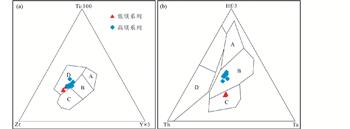
海南岛西部的军营-邦溪地区产出一套变质的、晚古生代镁铁质-超镁铁质熔岩系列。根据地质学、岩石学、矿物学和地球化学研究,该套岩石可划分为高镁和低镁两个系列,前者以高镁(Mg#=76.9~81.3) 为特征,后者以低镁(Mg#=40.7~48.4)、高钛含量(2.34%~3.27%) 为特征。这套镁铁质-超镁铁质熔岩具有LREE富集[(La/Yb)N=2.40~7.58]和无明显Eu异常的稀土配分模式,以及无Nb亏损、但略具轻微Ta正异常的微量元素原始地幔标准化曲线;87Sr/86Sr (270Ma) 和εNd(270Ma) 比值的变化范围分别为0.70645~0.70956和+4.7~+6.5,这些地球化学特征与洋岛玄武岩(OIB) 极其相似。一些反映源区特征的比值,如Ta/Hf、Th/Nb、Nb/Zr、La/Ta、La/Sm、(La/Nb)PM、(Th/Ta)PM等均指示其地幔柱成因,是石榴子石二辉橄榄岩地幔低程度部分熔融形成的产物。橄榄石斑晶的矿物化学进一步揭示,岩石的高镁性质是由橄榄石堆晶引起的,而橄榄石斑晶低的Fo (68~77) 值,暗示其原始岩浆为低镁的玄武质岩浆;低镁系列相对于高镁系列明显低的Cr、Ni含量,说明岩浆随后发生了橄榄石和单斜辉石的分离结晶作用。军营-邦溪地区晚古生代OIB型洋岛玄武岩可能代表了东古特提斯洋在海南岛的又一记录,该认识对深入探讨华南古特提斯洋的演化及其在海南岛的响应提供了新的证据。
A suite of metamorphic mafic-ultramafic lavas outcrop in Junying-Bangxi area, Hainan Island, South China. Based on the geological, petrological, mineralogical and geochemical results, the Junying-Bangxi metamorphic mafic-ultramafic lavas can be classified into two major magma types, namely, the high-Mg and the low-Mg types, in which the former is high in Mg (Mg#=76.9~81.3), whereas the latter is high in TiO2 (2.34%~3.27%) but low in Mg (Mg#=40.7~48.4). The chondrite-normalized REE patterns of this suite of rocks appear LREE-riched type ((La/Yb)N=2.40~7.58) with no apparently Eu anomaly. Primitive mantle-normalized trace element patterns show no Nb depletion and slightly Ta positive anomaly. The 87Sr/86Sr (270Ma) and εNd(270Ma) values range from 0.70645 to 0.70956 and from +4.7 to +6.5, respectively. These geochemical characteristics are similar to that of ocean island basalt (OIB). Some trace element ratios characterizing the source regions, such as Ta/Hf, Th/Nb, Nb/Zr, La/Ta, La/Sm, (La/Nb)PM, and (Th/Ta)PM, reveal that the Junying-Bangxi lavas have affinity to OIB from intraplate magmatism associated with mantle plume activity. Electron microprobe analyses on olivine phenocrysts in the Junying-Bangxi ultramafic lavas further indicate that the high-Mg nature is caused by olivine accumulation. Combined with the low Fo (68~77) of olivine phenocrysts, we propose that the primary magma likely is low-Mg basaltic magma which have derived from the low degree partial melting of garnet lherzolite mantle. The lower contents in Cr and Ni for low-Mg type, relative to that for the high-Mg type, indicate fractional crystallization of olivine and clinopyroxene occurs subsequently. The Late Paleozoic OIB-type lavas in Junying-Bangxi area probably were produced in an extensional back-arc basin, owing to the subduction of Paleo-Tethys Ocean and the probably synchronous initiation of the mantle plume under South China continential margin. This suite of metamorphic mafic-ultramafic lavas, as new evidence, is significant for discussing the evolution of South China Eastern Paleo-Tethyan Ocean.