知识与财富的链接

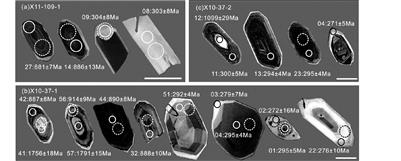
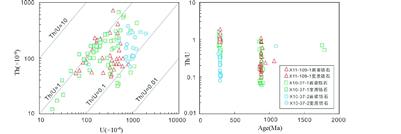
北山造山带是中亚造山带的重要组成部分,大量高级变质岩在北山造山带多个构造单元(地块)中广泛分布,被认为是造山带的前寒武纪基底,以往统称为“北山杂岩”。但是,对这些基底岩石的形成时代、来源与归属,以及是否经历了与造山作用过程相关的变质作用等问题的认识仍不清楚。本文对位于造山带南缘,即石板山地块的石板墩斜长角闪岩、白墩子片麻岩及其中长英质脉体进行了锆石U-Pb定年及Hf同位素研究。分析结果表明石板墩斜长角闪岩、白墩子片麻岩都具有~880Ma的原岩结晶年龄和~295Ma的变质作用年龄;白墩子长英质脉体的形成年龄与片麻岩的变质年龄一致,为~295Ma。此外,白墩子片麻岩及长英质脉体的锆石还记录了更晚一期270~280Ma的变质作用。石板墩斜长角闪岩、白墩子片麻岩中原岩结晶锆石的初始176Hf/177Hf值为0.282063~0.282291,εHf(t)为-6.3~2.2,tDM2分布于1.62~2.14Ga之间,表明其原岩的岩浆可能起源于古元古代地壳的部分熔融并有新生物质的贡献。这反映了北山造山带南缘可能并不存在太古代的地壳基底,即北山造山带南缘的石板山地块并不是前人所认为的属于敦煌地块的一部分。石板墩斜长角闪岩、白墩子片麻岩中的变质成因锆石初始176Hf/177Hf值明显高于原岩岩浆锆石,反映了它们不是由原岩锆石改造形成,而是熔体中的新生锆石,代表了一次~295Ma的深熔事件。这也得到了白墩子片麻岩中发育同时期长英质脉体的支持。我们认为这一~295Ma的深熔作用事件可能形成于后碰撞的伸展构造环境。
Beishan orogenic belt is an important part of the Central Asian Orogenic Belt (CAOB). A large number of high-grade metamorphic rocks are widely distributed in several Beishan orogenic tectonic units, which were considered as Precambrian basements and referred to the ‘Beishan complex’. However, their formation ages and tectonic attributions and whether they experienced metamorphism process associated with the orogeny are still unclear. Here, we present zircon U-Pb age and Hf isotopic compositions of Shibandun amphibolite, Baidunzi gneiss and felsic veins from the Shibanshan block, which is located in the southern margin of the Beishan orogenic belt. The results show that both Shibandun amphibolite and Baidunzi gneiss show similar ~880Ma protolith ages and ~295Ma metamorphic ages. The formation age of Baidunzi felsic veins is consistent with the metamorphic age of the gneiss. Furthermore, Baidunzi gneiss and felsic veins also recorded a later metamorphism age of 270~280Ma. The protolith crystallized zircons of Shibandun amphibolite and Baidunzi gneiss exhibit varied initial 176Hf/177Hf ratios (0.282063 to 0.
282291), εHf(t) values (-6.3 to 2.2) and tDM2model ages (1.62Ga to 2.14Ga), indicating that their protolith may be originated from a Paleoproterozoic crust with the addition of juvenile crust. Evidently, the Archean crustal basements would not occur in the southern Beishan orogenic belt, namely that the microcontinents in the orogen would not belong to the Dunhuang Block as previously considered. The metamorphic zircons of Shibandun amphibolite and Baidunzi gneiss have significantly higher initial 176Hf/177Hf ratios than their protolith counterparts, suggesting that they were formed by new zircon overgrowths in partial melts, rather than recrystallized from the protolith zircons. Therefore, the ~295Ma metamorphic event may represents an anatexis event, which is also supported by the simultaneous felsic veins occurred in the Baidunzi gneiss. We suggest that the ~295Ma anatexis events may be formed in a post-collisional extensional setting.